Cordless Brad Nailer Explained: A UK Buyer's Guide
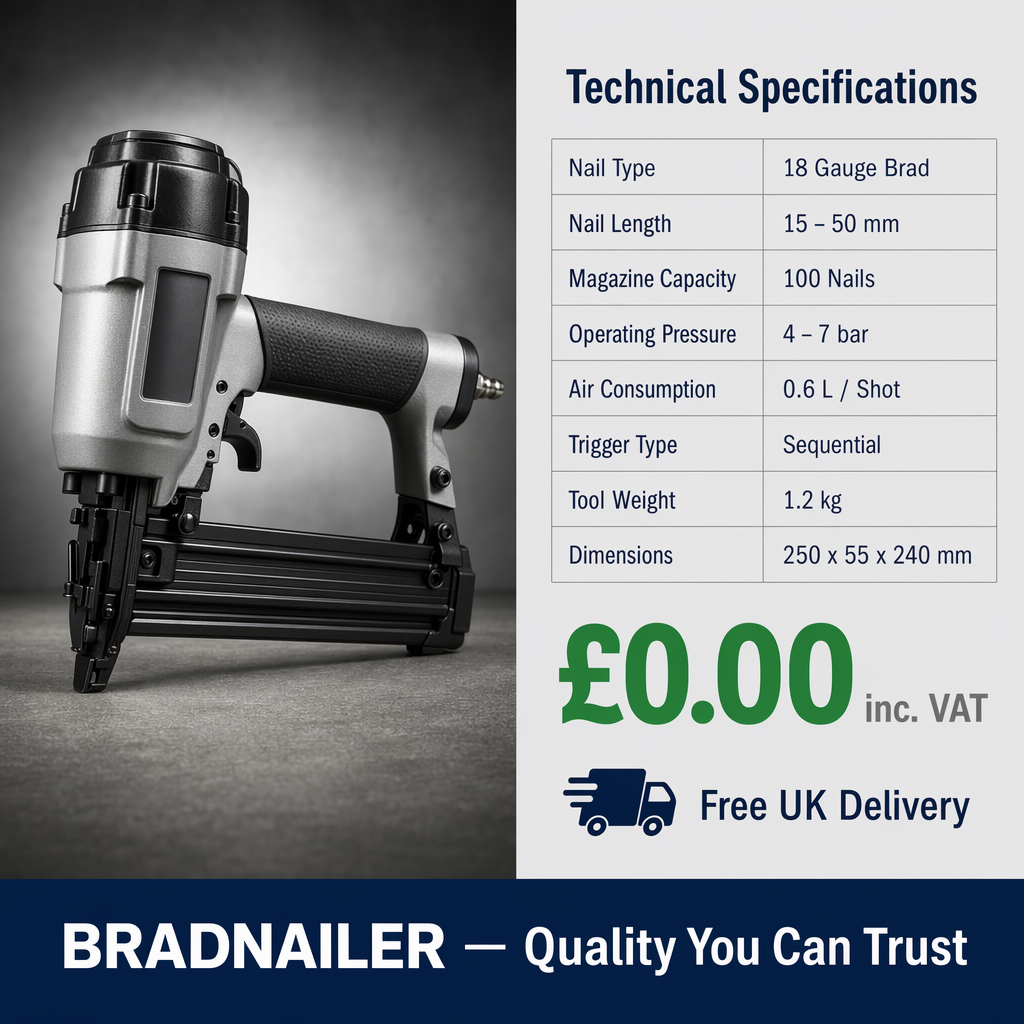
TL;DR: A cordless brad nailer is the best choice for most UK trim, skirting, architrave and panelling jobs because it drives slim 18-gauge brads without an air hose or compressor. Based on our testing, the best models are easy to carry, leave smaller holes than larger finish nailers, and save time on site and at home. Look for tool-free depth adjustment, dry-fire lockout, sensible weight with a 2.0Ah battery, and strong performance in common UK materials such as MDF, pine and oak.
A cordless brad nailer is a battery-powered nail gun designed to fire 18-gauge brads for second-fix carpentry, trim and decorative woodwork. For most UK users, it is the easiest way to fix skirting boards, architraves, beading and panelling quickly, cleanly and without the hassle of a compressor or trailing hose.
Dragging a 15kg air compressor up a narrow flight of Victorian terrace stairs is a rite of passage most UK carpenters would rather forget. However, tangled air hoses, noisy motors kicking in just as you try to speak to a client, and the constant search for an available 240V socket make pneumatic setups increasingly frustrating. The industry has shifted, and a reliable cordless brad nailer now offers comparable driving power without the restrictive tether.
At BradNailer, our technical team has spent years on sites, in workshops and testing tools in real-world conditions. Based on our testing across common UK second-fix tasks, we know what separates a cheap, jamming headache from dependable kit. Whether you are fitting architraves on a new-build estate or tackling weekend MDF panelling at home, this guide explains exactly what to look for before you buy.
Quick answer: what should you know about a cordless brad nailer?
- Gauge size: An 18-gauge cordless brad nailer fires a slim wire brad of roughly 1.02mm, leaving a very small hole that usually needs only minimal filler.
- Best use: It is ideal for skirting, architraves, beading, mouldings and light panel work where neat fixing matters.
- Safety benefit: Removing trailing air hoses can help reduce trip hazards in line with general UK Health and Safety Executive (HSE) good practice.
- Versatility: Some models are 2-in-1 tools that accept both 18g brads and narrow crown staples for broader use.
- Battery efficiency: In our experience, a standard 2.0Ah lithium-ion battery gives the best balance of runtime and handling for most trim jobs.
What is a cordless brad nailer?
A cordless brad nailer is an electric fastening tool that drives 18-gauge wire nails, usually called brads. Unlike pneumatic nailers, it does not need an external compressor or airline. Instead, it uses an onboard lithium-ion battery to power an internal mechanism that drives each brad into the material.
The reason this tool is so popular is simple: an 18-gauge brad is thin enough to leave a discreet fixing hole yet strong enough for many finishing jobs. As a result, it works especially well on skirting boards, architraves, quadrant beading and other decorative timber where appearance matters just as much as holding power.
Once fired slightly below the surface, the tiny hole is usually easy to hide with decorator's caulk or wood filler. Therefore, if your aim is neat second-fix work rather than heavy structural fixing, a cordless brad nailer is often the right tool.
For a broader look at different nailers on the market, read our comprehensive Nail Gun Explained: A UK Buyer's Guide. It covers everything from structural framing nailers to delicate 23-gauge pinners used for intricate mouldings.
What is a cordless brad nailer used for?
A cordless brad nailer is mainly used for light-to-medium finishing tasks where you want secure fixing with minimal surface damage. In UK homes and workshops, that usually means second-fix carpentry rather than first-fix structural work.
Common UK jobs for a cordless brad nailer
- Fixing skirting boards
- Installing architraves around internal doors
- Attaching decorative mouldings and beading
- Securing MDF wall panelling
- Pinning lightweight trims before adhesive sets
- Cabinet backing strips and light joinery tasks
Based on our testing, cordless brad nailers are especially useful when you need speed and mobility while moving room to room. For example, they are far more convenient than pneumatic setups when working in occupied homes or on snagging jobs with limited access.
Why are UK tradespeople and DIYers choosing cordless over pneumatic?
The move from pneumatic to battery power on UK sites is now well established. First of all, mobility is the biggest reason. Moving around a standard semi-detached house with no hose or compressor saves time immediately. You simply pick up the tool, fit the battery and start work.
Secondly, there is the safety factor. According to general HSE guidance on workplace risk reduction, avoiding unnecessary trailing equipment helps reduce trip hazards. In practical terms, removing an air hose from dusty floors and tight hallways makes domestic renovation work tidier and safer.
Noise matters too. A compressor kicking in early on a residential street rarely goes down well with neighbours or clients. By comparison, cordless models are quieter overall because there is no separate motor unit constantly cycling in the background.
Finally, setup time is dramatically lower. That makes a real difference for punch-list jobs, quick repairs and smaller carpentry tasks where dragging out full pneumatic kit feels excessive.
If you want a wider comparison of battery, gas and air-powered options across different use cases, see our guide to the Ultimate Guide to Brad Nailer Gun Cordless in the UK.
Is a cordless brad nailer worth it?
For most people searching for a cordless brad nailer in the UK, yes — it is worth it if you regularly do trim work or want cleaner results than hammer-and-nail fixing. Although upfront cost can be higher than an entry-level pneumatic gun alone, the convenience often outweighs that difference because you are not also dealing with hoses, compressors and extra setup.
Based on our testing across domestic fitting jobs, the value becomes obvious when working on stairs, in loft rooms or inside furnished homes where manoeuvrability matters most. In other words, if you want speed without sacrificing finish quality, cordless makes strong sense.
If you only ever tackle occasional heavy-duty workshop jobs beside an existing compressor setup, pneumatic can still be cost-effective. However, for general decorating prep and second-fix carpentry around UK homes, cordless tends to be the more practical option.
What should you look for when buying a cordless brad nailer?
Not all battery nailers perform to the same standard. Our team has tested budget models as well as premium trade tools across MDF trim, softwood mouldings and hardwood offcuts. Therefore, if you want reliable firing and less frustration on site or at home, focus on these key features.
How important are battery size and tool balance?
The battery affects both runtime and handling. A common mistake is choosing the largest pack available — such as 5.0Ah or 6.0Ah — even though most trim work does not need that much capacity in one session.
In practice, extra battery size adds weight at the base of the handle. Consequently, overhead work like coving or picture rail fixing becomes more tiring than it needs to be. Based on our testing, a compact 2.0Ah battery gives the best balance for most users because it keeps handling manageable while still delivering plenty of shots per charge.
Should you buy a 2-in-1 brad nailer and stapler?
If you want one tool to cover several light-duty tasks, a 2-in-1 model can be excellent value. These tools accept both straight 18g brads and narrow crown staples using one magazine system.
This added versatility helps if you move between trim installation and lighter fixing tasks such as attaching thin sheet material or fabric-backed components. Even so، if your work is almost entirely decorative timber trim، a dedicated brad-only model may feel simpler day to day.
If you want more detail on staple sizes and applications، read our guide: Staple Explained: A UK Buyer's Guide.
Ready to try BradNailer?
Shop Now — £19.99